
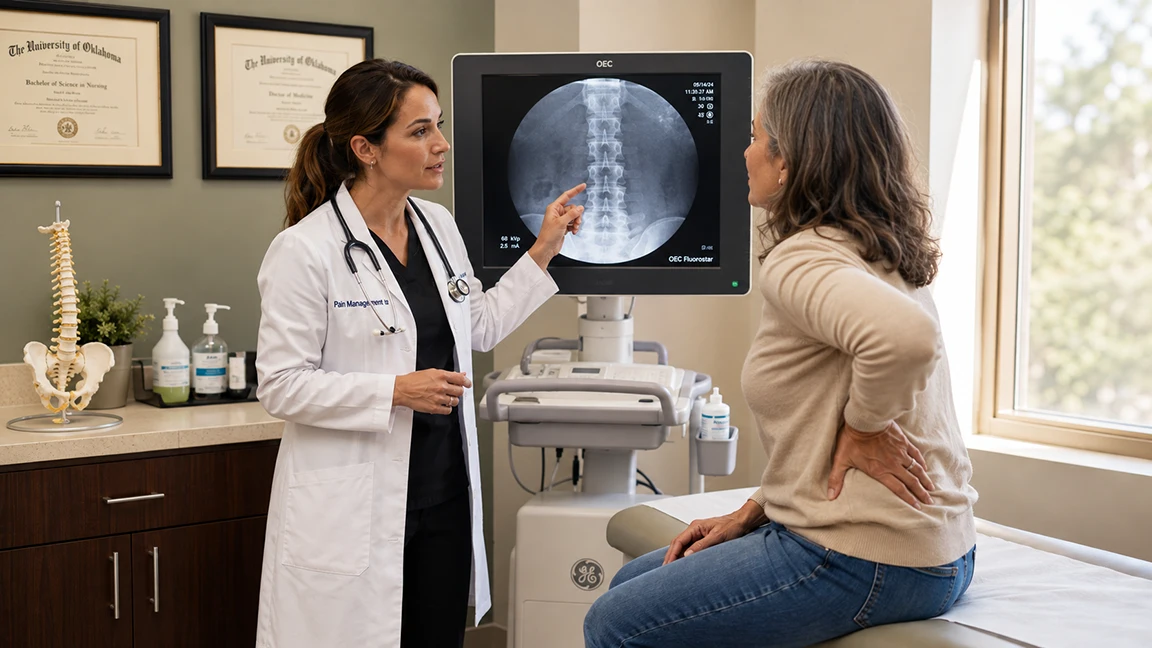
A medial branch block is a diagnostic injection that uses local anesthetic to temporarily numb the medial branch nerves — the small sensory nerves that carry pain signals from spinal facet joints. If your pain significantly decreases for several hours after the injection, it confirms the facet joints as the source and opens the door to longer-lasting treatments like radiofrequency ablation.
What Is a Medial Branch Block?
A medial branch block is a targeted diagnostic injection used in interventional pain management to determine whether the facet joints in your spine are causing your chronic back or neck pain. It works by temporarily interrupting the pain signals traveling from those joints through specific small nerves.
Every vertebra in your spine has facet joints on both sides that allow your back to bend, twist, and move. When these joints become arthritic or inflamed, they can produce persistent pain — but pinning down whether the facet joints are actually responsible for a given patient’s pain isn’t always straightforward, since imaging can show joint damage that isn’t causing symptoms, and pain can radiate in patterns that mimic other conditions.
That’s where the medial branch block comes in. The medial branch nerves are the small sensory nerves that carry pain signals from each facet joint to the spinal cord. By injecting a small amount of local anesthetic directly onto these nerves, a pain specialist can temporarily block the pain signals. If your pain significantly decreases in the hours following the injection, it confirms that the facet joints were indeed the source. If the pain stays the same, the search for the true pain generator continues elsewhere.
Because the primary purpose is diagnostic rather than therapeutic, medial branch blocks are typically brief in their effect — most patients experience relief for just a few hours to a day. The value isn’t in long-term pain relief but in the clarity the block provides about where the pain is coming from, which shapes the next step in treatment.
What Are the Types of Medial Branch Blocks?
Medial branch blocks are named for the region of the spine being tested. The procedure is the same across all three types — only the location and specific nerves targeted differ. When both sides of the same spinal level are treated in one session, that’s called a bilateral medial branch block.
Cervical Medial Branch Block
Targets the medial branch nerves in the neck (cervical spine, C2 through C7). Used to diagnose neck pain, upper back pain, or pain radiating into the shoulders that hasn’t responded to more conservative treatment. Cervical procedures require particularly precise needle placement given the small size and delicate structures of the neck.
Thoracic Medial Branch Block
Targets nerves in the mid-back region (thoracic spine, T1 through T12). Thoracic facet joints are a less common source of pain than cervical or lumbar joints, but when they are the culprit, this diagnostic block can pinpoint the affected level and inform next steps in treatment.
Lumbar Medial Branch Block
Targets nerves in the lower back (lumbar spine, L1 through L5). The most commonly performed of the three, since lumbar facet joints are frequently involved in chronic low back pain. Pain typically stays localized to the lower back and buttocks and rarely radiates below the knee, distinguishing it from disc-related nerve pain.
How Is a Medial Branch Block Performed?
A medial branch block is an outpatient procedure that typically takes less than 30 minutes from start to finish. Real-time fluoroscopic (X-ray) guidance is used throughout to ensure precise needle placement near the target nerves.
- Preparation. You’ll change into a gown and lie face down on a fluoroscopy table — a specialized X-ray table that allows the physician to visualize your spine in real time. The skin over the injection site is cleaned with antiseptic solution, and a small amount of local anesthetic numbs the area to minimize discomfort during needle placement.
- Imaging guidance. Using the fluoroscopy monitor, the physician identifies the exact vertebral level and target nerves. Contrast dye may be injected first to confirm the needle’s position before delivering the anesthetic.
- Needle placement. A thin, specialized needle is advanced through the skin to the medial branch nerves at the target level. Multiple nerves may be targeted in a single session — often bilateral (both sides of the spine at the same level) since facet joint problems frequently affect matching joints on both sides.
- Anesthetic injection. A small amount of local anesthetic — sometimes combined with a small dose of steroid — is injected precisely onto each targeted nerve. You may feel pressure or a brief stinging sensation. The full injection takes only seconds per nerve.
- Recovery and observation. You’ll rest in a recovery area for about 15 to 30 minutes so staff can monitor for any immediate reactions. Most patients drive themselves home unless sedation was used.
- Pain diary. In the hours after the procedure, you’ll track your pain level carefully. A significant reduction in your usual pain during the anesthetic’s window of effect confirms the facet joints as your pain source.
How Long Does a Medial Branch Block Last?
Because a medial branch block is primarily diagnostic, the pain relief it provides is intentionally short-lived. Most patients experience relief lasting several hours to about a day — enough time to confirm whether the facet joints were the source but not intended as long-term therapy.
The exact duration depends on the specific anesthetic used. Some anesthetics wear off within 3 to 4 hours; others provide relief lasting closer to 8 to 12 hours. If a small dose of steroid is included with the anesthetic (which some providers add for combined diagnostic and therapeutic benefit), pain relief may extend for several weeks before returning.
The duration is essentially the same whether the block is performed in the cervical, thoracic, or lumbar region — the procedure and its therapeutic window don’t vary meaningfully by spine level.
If your pain significantly decreases during the block’s window of effect and then returns to baseline as the anesthetic wears off, that pattern actually represents a successful outcome from a diagnostic standpoint. It confirms the facet joints as your pain source and opens the door to longer-lasting treatments like radiofrequency ablation.
What Are the Side Effects of Medial Branch Blocks?
Medial branch blocks are considered very safe when performed by experienced pain specialists using imaging guidance. Serious complications are rare, but understanding the potential side effects helps patients know what to expect.
Common side effects include:
- Soreness at the injection site for 24 to 48 hours
- Mild bruising around the injection area
- Temporary numbness in the injected region
- Slight increase in pain during the first day
- Facial flushing if steroid is included in the injection
Less common side effects include headache, temporary elevation of blood sugar (relevant for patients with diabetes when steroid is used), and brief allergic reactions to the injection medications. Serious complications like infection, significant bleeding, or nerve damage are very rare with proper technique and imaging guidance.
Cervical medial branch blocks carry some location-specific considerations due to the delicate anatomy of the neck. Temporary voice changes, transient facial numbness, or brief difficulty swallowing can occur but typically resolve within hours. These effects reflect the proximity of the injection site to other sensory nerves rather than complications of the block itself.
Patients on blood thinners may need medication adjustments before the procedure. Discussing all current medications with your pain specialist ensures appropriate precautions.
Worse Pain After Medial Branch Block
Some patients experience an increase in pain during the first 24 to 48 hours after a medial branch block. This temporary flare can feel alarming — especially when the whole point of the injection was to identify a pain source, not create a new one — but it’s a well-documented and usually short-lived reaction.
The flare typically stems from the physical process of needle placement irritating surrounding tissue, the anesthetic wearing off before the injection-related inflammation subsides, or muscle soreness from the position held during the procedure. Ice applied to the injection site during the first 24 hours and over-the-counter pain relievers help manage the transition.
For most patients, this discomfort resolves within a few days. Pain that becomes severe, is accompanied by fever, unusual weakness, or bladder or bowel changes deserves prompt medical attention. These symptoms are rare but warrant immediate contact with the pain specialist.
Importantly, worse pain in the days after the block doesn’t reflect on whether the block succeeded diagnostically. The diagnostic window — those hours immediately after the injection when the anesthetic was active — is what matters for interpreting the results, not the post-procedure soreness.
Medial Branch Block vs. Facet Joint Injection
Both medial branch blocks and facet joint injections address pain from spinal facet joints, but they work differently and serve different purposes.
| Factor | Medial Branch Block | Facet Joint Injection |
|---|---|---|
| Primary purpose | Diagnostic — confirms facet joints as pain source | Therapeutic — reduces inflammation and pain |
| Injection target | Medial branch nerves outside the joint | Inside the facet joint capsule |
| Medication used | Local anesthetic (sometimes with small steroid dose) | Steroid combined with local anesthetic |
| Duration of relief | Hours to a day (weeks if steroid added) | Weeks to several months |
| Typical next step | Radiofrequency ablation if diagnostic | Repeat injection or physical therapy |
| Best use case | When ablation is being considered | When ongoing inflammation reduction is the goal |
Both procedures are safe and minimally invasive, and both are performed under fluoroscopic guidance. The choice between them depends on your specific pain pattern, prior treatment history, and whether your provider is trying to diagnose the source or treat existing inflammation.
How Much Does a Medial Branch Block Cost?
Medial branch block costs vary based on several factors:
| Factor | Impact on Cost |
|---|---|
| Number of levels treated | More levels = higher cost |
| Bilateral vs. unilateral | Bilateral (both sides) costs more than unilateral (one side) |
| Facility type | Hospital-based procedures cost more than outpatient clinic procedures |
| Geographic location | Regional cost variation is significant |
| Insurance coverage | Coverage level determines out-of-pocket expense |
Most major insurance plans, including Medicare, cover medial branch blocks when medical necessity is documented. Insurance authorization typically requires evidence that conservative treatments have not provided adequate relief and that imaging or clinical examination supports facet joint involvement.
For patients without insurance coverage, out-of-pocket costs typically range from several hundred to over a thousand dollars depending on the number of levels treated and the facility. Contacting the pain management clinic directly for a personalized cost estimate is the most reliable way to plan financially.
What Is the Next Step After a Medial Branch Block?
The next step after a medial branch block depends entirely on how your pain responded during the diagnostic window.
If your pain decreased significantly — typically defined as at least 50 to 80 percent reduction — during the hours the anesthetic was active, the block is considered successful. This confirms the facet joints as your pain source and makes you a strong candidate for radiofrequency ablation, a longer-lasting treatment that uses controlled heat to disrupt the same medial branch nerves. Because ablation effectively silences the pain signals for six months to two years, most patients who respond well to a medial branch block go on to pursue ablation as the definitive next step.
Many pain specialists require a second confirmatory medial branch block before proceeding to ablation. This second block, sometimes called a confirmatory or repeat diagnostic block, reduces the chance of a false-positive result and helps ensure that ablation will be effective. Two blocks together provide a much higher predictive value than a single block alone.
If your pain didn’t change significantly during the diagnostic window, the medial branch block has told your provider something equally important — the facet joints likely aren’t your pain source. Treatment then shifts toward investigating other potential origins, such as intervertebral discs, sacroiliac joints, nerve roots, or soft tissue structures.
What If Medial Branch Block Doesn’t Work?
When a medial branch block doesn’t produce meaningful pain relief, it’s most likely providing valuable diagnostic information: your facet joints probably aren’t the primary source of your pain. That’s a useful finding, even though it can feel discouraging in the moment.
The next step is typically a re-evaluation with your pain specialist to explore other potential pain sources. Depending on your symptoms and imaging, alternative diagnostic approaches might include:
- Discography or provocative disc testing to evaluate the intervertebral discs
- Sacroiliac joint injections to rule out or confirm SI joint involvement
- Selective nerve root blocks to evaluate specific nerves
- Trigger point injections to assess muscular sources of pain
- Advanced imaging like MRI with contrast to look for less obvious findings
Sometimes what appears to be a failed block is actually a technical issue rather than a true negative result. Factors like anatomical variations, needle placement, or the specific anesthetic used can occasionally produce equivocal results that warrant a repeat block before ruling out the facet joints entirely.
Rather than viewing an unsuccessful medial branch block as a failure, pain specialists treat it as diagnostic information that redirects the search toward the actual pain source. This process of systematic elimination often ends up producing more targeted, effective treatment than starting with assumptions about where the pain originates.
When a Medial Branch Block Points Toward Radiofrequency Ablation
A successful medial branch block is often the gateway to more lasting relief. For patients whose pain responds well to the diagnostic block, radiofrequency ablation uses the same targeting principle to disrupt the medial branch nerves more permanently — providing relief that typically lasts six months to two years rather than hours. The pathway from diagnostic block to therapeutic ablation is one of the most well-established sequences in interventional pain management.
Take the Next Step Toward Diagnostic Clarity
Chronic back or neck pain that hasn’t responded to conservative treatment deserves a systematic approach to finding its true source. A medial branch block provides the diagnostic clarity that can transform vague, ongoing pain into a treatable, targetable condition — opening the door to therapies that actually work for your specific situation.
Access Pain Solutions provides medial branch blocks and the full range of interventional pain management at five locations across northeastern Oklahoma — Tulsa, Sand Springs, Muskogee, Okmulgee, and Vinita. Our experienced pain specialists use precise imaging guidance and evidence-based protocols to help identify your pain source and develop a treatment plan tailored to what’s actually driving your symptoms. To schedule a consultation, contact the Access Pain Solutions location nearest you.
Frequently Asked Questions About Medial Branch Blocks
Is a Medial Branch Block the Same as an Epidural?
No — while both are spinal injections, they target different structures for different purposes. An epidural steroid injection delivers medication into the epidural space surrounding the spinal cord to reduce inflammation of nerve roots, typically treating radiating pain from herniated discs or spinal stenosis. A medial branch block targets the specific medial branch nerves outside the facet joints to diagnose whether those joints are the pain source. Different location, different purpose, different medication mix.
Do They Sedate You for a Medial Branch Block?
Most medial branch blocks are performed with only local anesthetic to numb the injection site, without additional sedation. Because the procedure is brief and diagnostic accuracy depends on the patient being able to report pain levels afterward, sedation is typically avoided. Some providers offer mild oral sedation for patients with significant anxiety, but this is the exception rather than the rule.
How Painful Is a Medial Branch Block?
Most patients describe the sensation as pressure with brief stinging during the injection itself. The skin is numbed first with local anesthetic, and the needle placement is guided by imaging to minimize tissue disruption. The entire injection takes only seconds per nerve. Post-procedure soreness for 24 to 48 hours is common but typically mild and responds well to ice and over-the-counter pain relievers.
How Long Does a Lumbar Medial Branch Block Last?
A lumbar medial branch block provides pain relief for several hours to about a day when only local anesthetic is used. If a small dose of steroid is included, relief may extend for several weeks. The short duration is intentional — the block’s primary value is diagnostic rather than therapeutic.
How Long Does a Cervical Medial Branch Block Last?
A cervical medial branch block lasts a similar duration to lumbar or thoracic blocks — typically several hours to a day when local anesthetic alone is used, or several weeks when steroid is added. The specific spinal level being treated doesn’t meaningfully change the timing of the anesthetic’s effect.
What Causes Leg Weakness After a Medial Branch Block?
Temporary leg weakness after a lumbar medial branch block is uncommon but can occur when the local anesthetic spreads slightly and affects nearby motor nerve fibers. This effect is typically brief, lasting only a few hours until the anesthetic wears off, and full motor function returns as sensation returns. Weakness that persists beyond the expected anesthetic window or that’s accompanied by numbness spreading below the waist warrants prompt medical attention.
What Is the CPT Code for a Medial Branch Block?
The CPT codes for medial branch blocks fall in the 64490 to 64495 range, with the specific code depending on the spinal region and number of levels treated. Your insurance verification staff or billing office can provide the exact codes used for your specific procedure. These codes are primarily used for billing and insurance processing rather than being something patients typically need to know.