
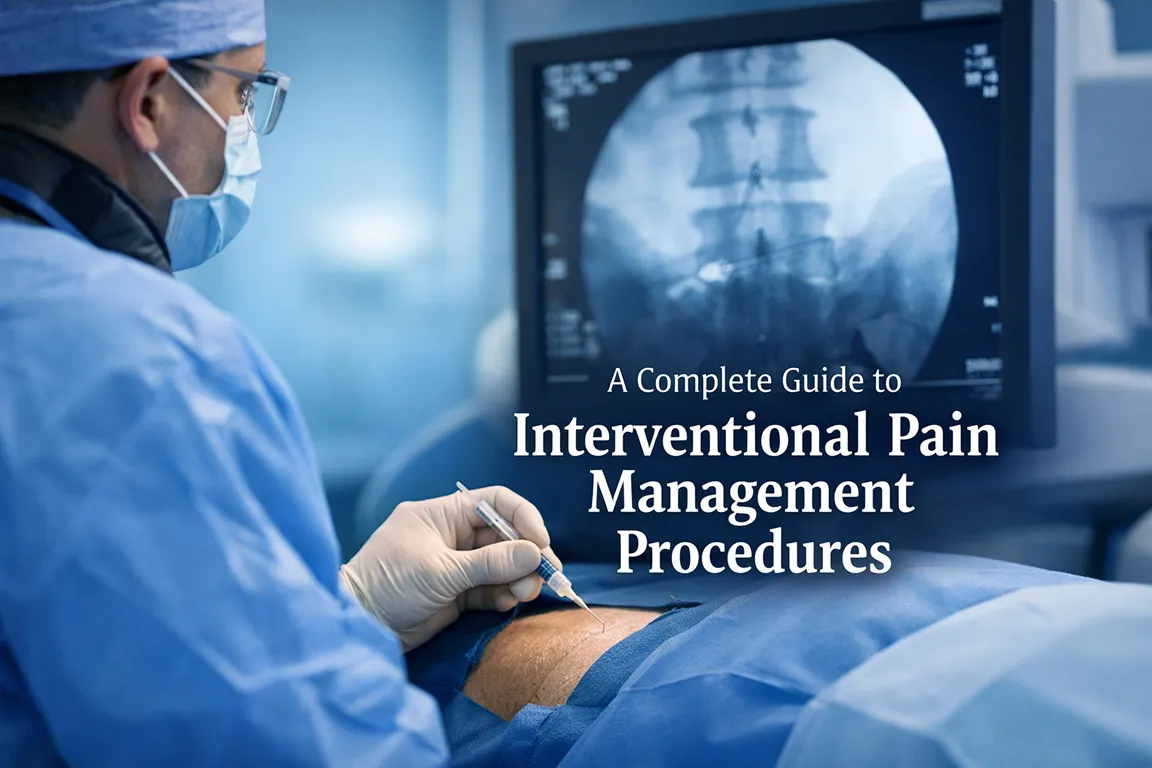
Chronic pain rarely improves on its own, and the medications that mask it often come with side effects that compound over time. Interventional pain management offers a different approach — using targeted, minimally invasive procedures to treat pain at its source rather than throughout the entire body.
A pain specialist who practices interventional pain management has trained beyond general anesthesiology, physiatry, or neurology to perform a specific set of image-guided procedures: injections, nerve blocks, radiofrequency ablation, neuromodulation, and more. Each procedure has a particular role, and most patients work through several types over the course of treatment as their pain evolves.
What Is Interventional Pain Management?
Interventional pain management is a medical subspecialty focused on diagnosing and treating chronic and acute pain through minimally invasive procedures. Unlike treatments that rely solely on systemic medications, interventional approaches deliver therapy directly to a specific nerve, joint, disc, or muscle — the exact location generating the pain signal.
This precision matters for two reasons. First, targeted delivery often produces better relief at much lower medication doses, which reduces side effects. Second, knowing exactly where pain originates is itself useful information; the diagnostic clarity from a well-placed procedure can shape the entire treatment plan moving forward.
Most interventional procedures are performed using imaging guidance — typically fluoroscopy (real-time X-ray) or ultrasound. This guidance allows the physician to see anatomical structures in real time and place a needle within millimeters of the target. The procedures themselves are usually performed in an outpatient setting, take less than an hour, and most patients walk out the same day with minimal downtime.
A few characteristics define the field as a whole:
- Procedures are minimally invasive — needles and small probes rather than open surgery
- Imaging guidance ensures precise placement
- Treatment targets a specific anatomical source rather than the whole body
- Most procedures are diagnostic, therapeutic, or both
- Patients typically return to normal activities within days
The major procedure categories used in interventional pain management each address a distinct type of pain source. Understanding what each one treats — and how they fit together — clarifies what a treatment plan might involve.
Diagnostic Procedures: Finding the Pain Source
Sometimes the most important question in pain management isn’t how to treat pain — it’s where pain is coming from. Imaging can reveal structural problems, but a herniated disc on an MRI doesn’t always cause symptoms, and a normal MRI doesn’t rule out a real pain source.
Diagnostic procedures fill that gap. By temporarily numbing a specific nerve or joint and observing whether pain resolves, a pain specialist can confirm or rule out a particular structure as the pain generator. Diagnostic nerve blocks are used for exactly this purpose, often before a more definitive procedure is recommended.
Medial branch blocks are a specific type of diagnostic injection used to evaluate facet joint pain in the spine. If a medial branch block significantly reduces pain for several hours, it confirms the facet joints as the source — and opens the door to longer-lasting treatments like radiofrequency ablation. If the block doesn’t help, the search shifts to other potential causes.
This diagnostic-first approach prevents unnecessary procedures and gives both patient and physician clearer expectations about what treatment will actually work.
Injection-Based Therapies
Injections are the workhorses of interventional pain management. The same general principle applies across most injection types: a combination of local anesthetic and anti-inflammatory medication is delivered precisely to the source of pain, interrupting pain signals and reducing the inflammation driving them.
Epidural steroid injections treat pain caused by inflamed spinal nerves — most commonly from a herniated disc, spinal stenosis, or radiculopathy that radiates into an arm or leg. The medication is delivered into the epidural space surrounding the spinal cord, where it bathes the irritated nerve roots and reduces the inflammation that produces shooting, burning, or radiating pain.
Facet joint injections target the small joints connecting each vertebra to the next. These joints can become arthritic or inflamed, producing localized back or neck pain that worsens with movement. A facet joint injection delivers steroid directly into the joint capsule, calming inflammation and confirming whether the facet joints are responsible for the pain.
Sacroiliac joint injections address pain from the joint where the sacrum meets the pelvis — a frequently missed cause of low back, buttock, and hip pain. SI joint dysfunction often masquerades as sciatica or hip arthritis, and a properly placed injection both treats the pain and confirms the diagnosis.
Trigger point injections treat the knots of hyperirritable muscle that develop in chronic pain syndromes, post-injury patterns, and conditions like fibromyalgia. A small amount of anesthetic injected directly into the trigger point breaks the cycle of muscle spasm and referred pain.
Cortisone injections is a broader category covering steroid-based procedures like epidural steroid injections, facet joint injections, and trigger point injections, along with intra-articular cortisone shots for arthritic joints in the knee, shoulder, hip, and elsewhere. The general principles of anti-inflammatory action, targeted delivery, and variable duration of relief apply across this family of injection types.
Targeted Nerve Blocks for Specific Pain Conditions
Nerve blocks become particularly useful when pain follows a specific nerve’s distribution rather than affecting a joint or broader region. Choosing the right block depends on what nerve is involved and where the pain travels.
For headaches and pain originating at the base of the skull, occipital nerve blocks target the greater and lesser occipital nerves with small injections that can produce immediate relief from occipital neuralgia and certain headache patterns.
When CRPS or sympathetic-mediated pain affects an arm, stellate ganglion blocks interrupt the sympathetic chain at the base of the neck — and the same procedure is increasingly used for PTSD symptoms when other approaches haven’t helped. For corresponding lower-body conditions, lumbar sympathetic blocks target the sympathetic nerves in the lumbar spine to reduce CRPS pain in the leg and improve circulation when sympathetic overactivity drives symptoms.
Chest wall pain — from rib fractures, post-thoracotomy syndromes, or postherpetic neuralgia after shingles — responds well to intercostal nerve blocks placed along the underside of the affected ribs.
For chronic knee pain in patients who are not yet candidates for joint replacement, genicular nerve blocks target the small sensory nerves around the knee, used both diagnostically and therapeutically.
Radiofrequency Ablation for Longer-Lasting Relief
When injections provide good but temporary relief, the next logical step is often radiofrequency ablation — frequently called RFA. Unlike injections that deliver medication and gradually wear off over weeks or months, RFA uses heat from radio waves to disrupt the small sensory nerves carrying pain signals from a problem joint or structure.
The procedure is highly targeted. After a diagnostic block confirms which nerves are responsible, a thin probe is placed alongside those same nerves, and a controlled application of radiofrequency energy creates a small lesion that prevents pain signals from traveling. The treated nerve eventually regenerates, but relief typically lasts six months to two years — far longer than injection-based therapies.
RFA is most commonly used for facet joint pain in the spine and for genicular nerves around the knee. Some patients return for repeat ablations every couple of years and maintain meaningful function with minimal medication in between, while others may need diagnostic re-evaluation or alternative neuromodulation approaches if relief proves inconsistent.
Neuromodulation: Working With the Nervous System
Neuromodulation takes a fundamentally different approach. Rather than blocking pain pathways or reducing inflammation, it uses carefully controlled electrical signals to change how the nervous system processes pain. Three procedures dominate this category, each addressing a different anatomical scale.
Spinal cord stimulators target the central nervous system. A small device implanted under the skin delivers mild electrical pulses through thin leads placed in the epidural space along the spinal cord, interrupting pain signals before they reach the brain. The approach is well-established for failed back surgery syndrome, CRPS, diabetic neuropathy, and other forms of chronic neuropathic pain. Patients complete a trial period before committing to a permanent implant.
Peripheral nerve stimulation — PNS — works on the same principle but targets a specific peripheral nerve rather than the spinal cord. It’s particularly useful for localized neuropathic pain following surgery, injury, or nerve entrapment in an arm, leg, or other peripheral location.
PENS therapy — percutaneous electrical nerve stimulation — provides the least invasive form of electrical stimulation. Fine probes placed through the skin deliver scheduled treatment sessions rather than continuous stimulation from an implanted device. It can be useful both diagnostically and therapeutically, and it often makes sense for patients who want to test their response to electrical stimulation before considering an implantable option.
Procedures for Spinal Compression Fractures
Vertebral compression fractures — small breaks in the bones of the spine, usually from osteoporosis — can produce severe, persistent back pain that doesn’t respond to standard treatment. Two procedures restore vertebral height and stabilize the fracture from the inside.
Kyphoplasty involves inserting a small balloon into the fractured vertebra, gently inflating it to restore height, and then filling the cavity with bone cement to stabilize the structure. Pain relief is often dramatic within days, and patients regain function quickly.
Vertebroplasty is similar in principle but skips the balloon step — bone cement is injected directly into the fractured vertebra. It’s typically chosen when the fracture is too old or compressed for height restoration but still painful and unstable. Both procedures are performed on an outpatient basis and have transformed the outlook for older adults with osteoporotic spine fractures.
Specialty Procedures for Targeted Conditions
A handful of interventional procedures address very specific pain conditions. Botox treatment for chronic migraines delivers the same neurotoxin used cosmetically — but in a specific pattern around the head and neck — to reduce migraine frequency in patients with 15 or more headache days per month, with treatment repeated every twelve weeks. Hyaluronic acid injections for knee arthritis supplement the natural lubricating fluid in arthritic knee joints, often serving as an alternative or complement to cortisone shots for mild to moderate osteoarthritis. Intrathecal pain pumps deliver pain medication directly into spinal fluid through a small implanted device, achieving relief at a tiny fraction of the dose required orally — typically reserved for severe, treatment-resistant chronic pain or certain cancer pain syndromes.
Non-Invasive Adjunct Therapies
Not every effective pain treatment requires a needle. Infrared therapy for chronic pain uses specific wavelengths of light to penetrate tissue, reduce inflammation, improve circulation, and modulate pain at a cellular level. It can stand alone or work alongside other interventional procedures as part of a broader treatment plan — particularly for soft tissue pain, neuropathic conditions, and recovery from injury.
When Interventional Pain Management Makes Sense
Most patients arrive at interventional pain management after trying several other approaches — over-the-counter medications, physical therapy, perhaps a course of prescription pain relievers — without lasting success. Interventional procedures are rarely the first step. They’re considered when:
- Conservative treatments have not produced adequate relief
- Pain is interfering significantly with sleep, work, or daily function
- Medication side effects are becoming a problem
- The pain has a specific anatomical source that can be targeted
- A patient wants to avoid or delay surgery
- Imaging or examination points to a structure that’s a good interventional target
The first appointment with a pain specialist is typically focused on understanding the full picture: history, what’s been tried, what helps and what doesn’t, results of any imaging, and a thorough physical examination. Treatment recommendations are personalized to the specific pain pattern, the patient’s broader health, and what other treatments are already in place.
Importantly, interventional procedures are not a replacement for the rest of a pain management plan. Physical therapy, lifestyle modifications, mental health support, medication management, and rehabilitation all remain part of the picture. The goal of any interventional procedure is to reduce pain enough to make those other components effective.
Take the Next Step Toward Pain Relief
If chronic pain is affecting your quality of life, an evaluation with an interventional pain specialist can help clarify what’s driving it and what treatment options are most likely to work for your specific situation.
Access Pain Solutions provides comprehensive interventional pain management at five locations across northeastern Oklahoma — Tulsa, Sand Springs, Muskogee, Okmulgee, and Vinita. Our team includes pain specialists, nurse practitioners, and physician assistants experienced across the full range of interventional procedures. To schedule a consultation or learn whether a specific procedure might be right for you, contact the Access Pain Solutions location nearest you.