
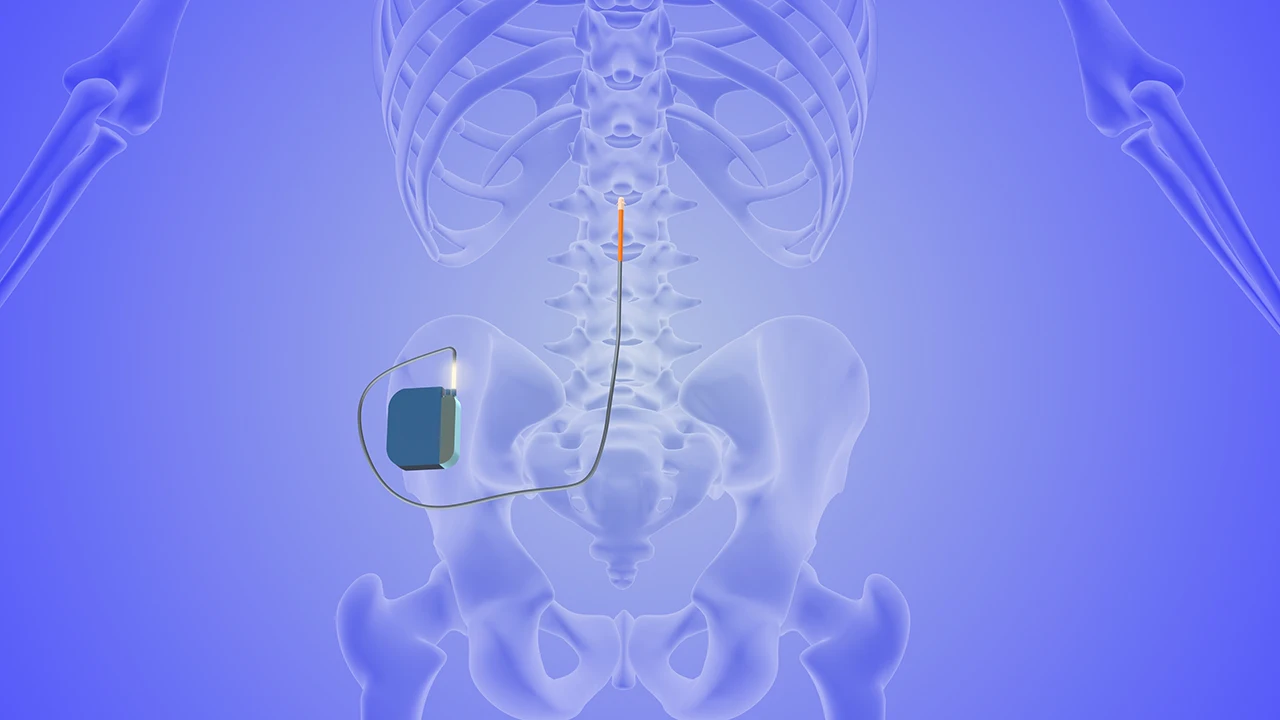
A spinal cord stimulator is a small implanted device that delivers mild electrical pulses to the spinal cord, interrupting pain signals before they reach the brain. Treatment happens in two phases — a short trial to confirm it works for you, followed by a permanent implant if the trial succeeds. It’s used for chronic back, leg, and nerve pain that hasn’t responded to other treatment.
What Is a Spinal Cord Stimulator?
A spinal cord stimulator is an implantable device that manages chronic pain by delivering low-level electrical pulses to the spinal cord. As one of the most established tools in interventional pain management, it’s designed for people whose pain persists despite medication, physical therapy, injections, or even prior surgery.
The system has three parts. A pulse generator — essentially a small battery and computer — produces the electrical signals. Thin wires called leads carry those signals to precise points along the spinal cord. A handheld remote lets you turn the stimulation on and off and adjust its strength throughout the day.
What makes a spinal cord stimulator different from most pain treatments is that it doesn’t mask pain with medication or treat a single structure with an injection. It changes how the nervous system transmits pain signals in the first place. And because it’s always reversible and tested before it’s made permanent, patients get to find out whether it works for them before committing to the implant.
How Does a Spinal Cord Stimulator Work?
A spinal cord stimulator works by sending mild electrical pulses to the nerves of the spinal cord, interrupting pain signals on their way to the brain. When those signals are disrupted, the brain registers far less pain — and in many cases, the sharp or burning sensation is replaced by a mild tingling or by nothing noticeable at all.
The device targets the dorsal columns of the spinal cord, the pathway that carries sensory information upward. By stimulating this pathway, the device effectively changes the message the brain receives. Modern systems offer several stimulation patterns, including options that produce no tingling sensation whatsoever, and the settings can be fine-tuned to each person’s pain.
Control stays in the patient’s hands. Using the remote, you can raise or lower the intensity, switch between programs for different activities, and turn the device off entirely when you don’t need it. This adaptability is a large part of why stimulation can remain effective across the ups and downs of daily life.
What Conditions Does a Spinal Cord Stimulator Treat?
Spinal cord stimulators are used for chronic pain that has resisted other treatments, particularly nerve-related (neuropathic) pain. Common conditions include:
- Failed back surgery syndrome — persistent back or leg pain after spine surgery
- Complex regional pain syndrome (CRPS)
- Diabetic peripheral neuropathy and other forms of nerve damage
- Chronic radiculopathy, including ongoing sciatica-type pain
- Arachnoiditis — inflammation of the membrane surrounding spinal nerves
- Chronic leg or arm pain that hasn’t responded to conservative care
A spinal cord stimulator is rarely a first step. It’s considered after more conservative options have been tried, and it works best for well-defined pain that has a clear neuropathic component. The trial phase exists precisely to confirm the device will help a given person before anything permanent is done.
What Happens During a Spinal Cord Stimulator Trial?
A spinal cord stimulator trial is a temporary, low-commitment test of stimulation before anything permanent is implanted. The physician places thin leads through a needle and connects them to a small external generator worn on a belt or waistband, and you live with the device for several days to see how much it reduces your pain during normal activity.
The trial generally follows a few steps:
- Lead placement. Using fluoroscopic (X-ray) guidance, the physician positions temporary leads in the epidural space near the target area of the spinal cord. No incision is needed — the leads go in through a needle.
- Programming. The leads connect to an external generator, which is programmed to cover the area of your pain. You’ll learn to use the remote.
- The test period. You wear the system at home and keep a simple pain diary, noting how activities, sleep, and daily tasks feel compared to before.
- Evaluation. You return to have the leads removed and review results. A reduction of about 50% or more in pain is the usual threshold for considering the permanent implant.
A spinal cord stimulator trial typically lasts five to seven days. That window is long enough to judge real-world relief without the leads needing to stay in longer. Because the trial is temporary and reversible, it carries very little risk and gives both you and your physician concrete evidence before moving forward.
How Is a Spinal Cord Stimulator Implanted?
If the trial succeeds, the permanent spinal cord stimulator is implanted during a minimally invasive outpatient procedure. The leads are placed much like they were in the trial, but this time the generator is implanted under the skin so the entire system is internal.
- Preparation and anesthesia. You’re positioned face down and given sedation or light general anesthesia for comfort.
- Lead placement. Permanent leads are guided into the epidural space under fluoroscopy and secured in position.
- Generator pocket. The physician makes a small incision and creates a pocket under the skin — usually in the upper buttock or flank — to hold the pulse generator.
- Connection and testing. The leads connect to the generator, placement is confirmed, and the incisions are closed.
- Recovery. After a short monitored recovery, you go home the same day.
Here’s what the surgery looks like at a glance:
| Detail | What to Expect |
|---|---|
| Setting | Outpatient — most patients go home the same day |
| Anesthesia | Light sedation or general anesthesia, depending on the case |
| Duration | Roughly 1 to 2 hours |
| Incisions | One or two small incisions (generator pocket and lead entry) |
| Lead placement | Thin leads positioned in the epidural space under fluoroscopy |
| Generator location | A small pocket under the skin, usually the upper buttock or flank |
Most patients find the procedure far less painful than expected. The incisions are small, discomfort during the surgery is controlled by the anesthesia, and the soreness afterward is typically manageable with short-term measures.
What Is the Recovery Time After Spinal Cord Stimulator Surgery?
Most people recover from spinal cord stimulator surgery over about two to four weeks, though light daily activity resumes much sooner. The first week or two centers on protecting the incisions and letting the leads settle into a stable position before the body heals around them.
Soreness around the generator pocket and incision sites is normal for the first several days and responds well to ice and prescribed or over-the-counter pain relief. The priority during early healing is avoiding movements that could shift the leads before scar tissue anchors them.
Driving usually resumes once you’re off any prescription pain medication and can move comfortably — often within one to two weeks, and only with your physician’s clearance. Until then, arrange rides for the first several days.
Sleep is more comfortable on your back or side in a neutral position during the first couple of weeks. Avoid sleeping on the stomach, which can strain the healing areas, and use pillows to stay supported through the night. As healing progresses, these precautions ease and normal routines return.
What Are the Restrictions With a Spinal Cord Stimulator?
Most restrictions with a spinal cord stimulator are temporary, meant to protect the incisions and leads while you heal. Only a few lasting habits remain once the device has fully settled.
During the first several weeks of recovery, avoid:
- Bending, twisting, or reaching overhead
- Lifting anything heavier than about five pounds
- Raising your arms above your head (for upper-back lead placements)
- Strenuous exercise, housework, or yard work
- Soaking the incisions — no baths, pools, or hot tubs until cleared
Once you’ve fully healed, you can return to the activities you’re used to — with just a few habits to keep in mind:
- Exercise is encouraged — walking, swimming, and low-impact activity are typically fine once your physician clears you
- Swimming and water activities are fine after full healing; the implanted device is sealed
- You can drive normally, though the stimulation should be turned off while driving
- Certain equipment (theft detectors, airport scanners, some medical procedures) requires awareness, and you’ll carry a device ID card
Your care team will tailor these guidelines to your specific device and lead placement, but the overall trajectory is a return to an active, normal life.
What Is the Success Rate of a Spinal Cord Stimulator?
Spinal cord stimulators have a strong track record, with most studies reporting that 50 to 70 percent of patients achieve meaningful, lasting pain relief. Success is generally defined as at least a 50 percent reduction in pain, along with improved function and reduced reliance on pain medication.
The built-in trial is a major reason outcomes are favorable. Because patients only proceed to a permanent implant after a successful trial, the people who get the device are those who have already demonstrated a strong response — which raises real-world success rates compared to treatments with no test phase.
Several factors influence long-term results: the specific diagnosis, how well-defined the pain is, realistic expectations, and staying engaged with device programming over time. Stimulation technology has also advanced considerably, and newer waveform options have improved relief for many people who didn’t respond as well to older systems.
What Are the Side Effects of a Spinal Cord Stimulator?
Most side effects of a spinal cord stimulator are mild, temporary, and related to the implant settling in. Common ones include:
- Soreness or tenderness around the generator pocket and incision sites
- Mild swelling or bruising during early healing
- Temporary changes in the stimulation sensation with certain movements or positions
- A tingling sensation (paresthesia) where the device is covering your pain, if you’re using a program that produces one
- Skin sensitivity over the generator site
These effects typically fade as healing finishes and the device is programmed to your comfort. Stimulation that feels too strong, too weak, or oddly placed can usually be resolved with a programming adjustment rather than any further procedure.
What Are the Risks of a Spinal Cord Stimulator?
The risks of a spinal cord stimulator are the less common complications that can require medical attention or an additional procedure. Serious problems are uncommon, but understanding them matters for an informed decision:
- Infection at the incision or generator site, most likely in the first few weeks
- Lead migration — a lead shifting from its original position and changing or reducing coverage
- Lead or hardware malfunction, such as a broken connection or generator issue
- Dural puncture, which can cause a temporary spinal headache
- Scar tissue around the leads that gradually reduces effectiveness
- Unwanted changes in stimulation requiring reprogramming or, rarely, revision
Can You Have an MRI With a Spinal Cord Stimulator?
In many cases yes, but it depends on your specific device. Most modern spinal cord stimulators are “MRI conditional,” meaning an MRI is safe only under defined conditions — the right device settings, a compatible scanner strength, and sometimes limits on which body areas can be scanned.
Before any MRI, the stimulator is placed into a dedicated MRI mode, and the imaging team confirms your system’s requirements. Older systems were often not MRI compatible at all, which is why the specific model matters so much. This is especially relevant for spine patients, who frequently need future imaging.
Manufacturers including Abbott, Boston Scientific, Medtronic, and Nevro all offer MRI-conditional systems, though the exact conditions vary by model. You’ll receive an identification card listing your device’s details, and your physician and the MRI facility use it to confirm a scan can be done safely. The key is never to assume — always verify your specific device’s labeling before scheduling an MRI.
How Much Does a Spinal Cord Stimulator Cost?
Before insurance, a spinal cord stimulator trial generally runs about $1,000 to $5,000, and the permanent implant — device, procedure, and facility fees combined — typically falls between roughly $30,000 and $50,000, sometimes more. Most patients never pay those sticker prices, though. With insurance, your real cost is usually limited to your plan’s deductible and coinsurance. Several factors move where you land:
| Factor | Impact on Cost |
|---|---|
| Trial vs. permanent implant | The trial costs far less than the full implant |
| Facility type | Hospital settings generally cost more than outpatient surgical centers |
| Device and manufacturer | System type, features, and battery style affect device cost |
| Insurance coverage | Coverage level and plan structure determine out-of-pocket expense |
| Geographic location | Regional cost variation is significant |
Most major insurance plans cover spinal cord stimulators when medical necessity is documented and conservative treatments have been tried without adequate relief. The required trial actually supports coverage, since it provides objective evidence the device works for you.
Medicare covers spinal cord stimulator implants when the medical-necessity criteria are met, including a successful trial, with the patient responsible for standard deductibles and coinsurance. Because coverage details vary by plan, the most reliable way to understand your costs is to have the pain management clinic verify your benefits and any prior-authorization requirements before scheduling.
Want to know what your plan will cover?
Schedule a consultation →Living With a Spinal Cord Stimulator
Day-to-day life with a spinal cord stimulator revolves around the handheld remote, which lets you adjust intensity, switch between programs for different activities, and turn stimulation off when you don’t need it. Most people settle into a routine of small adjustments that fit their day — one program for sleeping, another for activity, and so on.
Battery type shapes part of the routine. Rechargeable generators are topped up with an external charger worn over the device for a short session every few days to a couple of weeks, and they can last a decade or more before needing replacement. Non-rechargeable generators skip the charging but are replaced through a minor outpatient procedure when the battery runs down, typically after several years. The generator swap is simpler than the original implant — the leads stay in place, and only the generator is exchanged.
Over time, periodic programming visits help keep stimulation matched to your pain, which can change as your body and activity levels shift. With the device settled and the settings dialed in, most people return to work, exercise, travel, and the activities that chronic pain had taken away.
When a Spinal Cord Stimulator Isn’t the Right Fit
A spinal cord stimulator is one of several neuromodulation options, and it isn’t always the best match for every pain pattern. When pain is localized to a single peripheral nerve rather than a broader region, peripheral nerve stimulation targets that specific nerve directly and may be the more precise choice. A pain specialist evaluates the location and nature of your pain, your history, and your goals to determine which approach fits best.
Take the Next Step Toward Relief
Chronic pain that hasn’t responded to medication, therapy, or surgery doesn’t have to be the end of the road. A spinal cord stimulator offers a tested, reversible path to lasting relief — and the trial means you find out whether it works for you before committing to anything permanent.
Access Pain Solutions provides spinal cord stimulator trials and implants along with the full range of interventional pain management at four locations across northeastern Oklahoma — Tulsa, Sand Springs, Muskogee, and Vinita. Our experienced pain specialists use precise imaging guidance and a thorough evaluation to determine whether stimulation is right for you and to guide you through every step. To schedule a consultation, contact the Access Pain Solutions location nearest you.
Frequently Asked Questions About Spinal Cord Stimulators
Is Spinal Cord Stimulator Surgery Outpatient?
Yes. Spinal cord stimulator surgery is a minimally invasive outpatient procedure, and most patients go home the same day. The implant typically takes one to two hours, followed by a short monitored recovery before discharge.
Are You Put to Sleep for Spinal Cord Stimulator Surgery?
It depends on the case. Spinal cord stimulator surgery is performed under either light sedation or general anesthesia, so you won’t feel pain during the procedure. Your care team recommends the right approach based on your health and the specifics of your implant.
How Long Is Spinal Cord Stimulator Surgery?
The permanent spinal cord stimulator implant usually takes about one to two hours, depending on lead placement and generator positioning. The temporary trial lead placement is quicker, often completed in under an hour.
How Painful Is Spinal Cord Stimulator Surgery?
Spinal cord stimulator surgery is generally far less painful than patients expect. Anesthesia controls discomfort during the procedure, and the incisions are small. Afterward, soreness around the generator pocket and incision sites lasts several days and is usually well managed with ice and short-term pain relief.
How Big Is the Incision for a Spinal Cord Stimulator?
A spinal cord stimulator implant usually involves one or two small incisions — one where the leads enter near the spine and one for the generator pocket, typically a couple of inches. The exact size depends on the device and the surgeon’s technique, but the incisions are small by design.
How Long Does a Spinal Cord Stimulator Trial Last?
A spinal cord stimulator trial typically lasts five to seven days. That window gives you enough time to judge how much the device reduces your pain during everyday activities before deciding whether to move forward with a permanent implant.
How Soon Can I Drive After Spinal Cord Stimulator Surgery?
Most people can resume driving within one to two weeks of spinal cord stimulator surgery, once they’re off prescription pain medication and can move comfortably — and only with physician clearance. Arrange for rides during the first several days of recovery, and keep stimulation turned off while driving.
How Should I Sleep After a Spinal Cord Stimulator Implant?
After a spinal cord stimulator implant, sleep on your back or side in a neutral position for the first couple of weeks, using pillows for support. Avoid sleeping on your stomach, which can strain the healing areas, and avoid positions that twist or bend the areas around the incisions until your physician says it’s fine.
Can You Exercise With a Spinal Cord Stimulator?
Yes. Once you’re fully healed and cleared by your physician, exercise is encouraged with a spinal cord stimulator. Low-impact activities like walking, swimming, and cycling are typically fine. Strenuous activity is limited only during the initial recovery weeks while the leads settle into place.
Can You Go Swimming With a Spinal Cord Stimulator?
Yes, once the incisions are fully healed. The implanted spinal cord stimulator is sealed, so swimming and other water activities are fine after recovery. Avoid submerging the incisions — pools, hot tubs, and baths — until your physician confirms healing is complete.
Can You Drive With a Spinal Cord Stimulator?
Yes. Once you’ve recovered from the implant, you can drive normally with a spinal cord stimulator. The stimulation should be turned off while driving, since position changes can alter the sensation. Day-to-day driving is otherwise unaffected.
Is the Abbott Spinal Cord Stimulator MRI Safe?
Abbott spinal cord stimulators are MRI conditional, meaning an MRI can be performed safely under specific conditions — the correct device mode, a compatible scanner, and any model-specific limits. As with all manufacturers, the exact conditions depend on your particular model, so the MRI facility verifies your device details using your identification card before any scan.
What Are the Symptoms of Spinal Cord Stimulator Rejection?
A spinal cord stimulator is not biologically rejected the way a transplanted organ can be, since the body doesn’t mount an immune response against the device. What people describe as rejection is usually a complication such as infection — signs include increasing redness, warmth, swelling, or drainage at the incision — or skin irritation over the generator. These are treatable, and if the device causes ongoing problems, it can be removed entirely.
Does Medicare Pay for a Spinal Cord Stimulator Implant?
Yes. Medicare covers spinal cord stimulator implants when medical-necessity criteria are met, including a successful trial and documentation that conservative treatments haven’t provided adequate relief. Patients are responsible for standard Medicare deductibles and coinsurance, and exact coverage depends on the specific plan.
How Does Spinal Cord Stimulator Battery Replacement Work?
Battery replacement depends on the generator type. Rechargeable generators are charged externally and can last a decade or more before needing replacement. Non-rechargeable generators are swapped through a minor outpatient procedure when the battery runs down, typically after several years. In either case, the replacement is simpler than the original implant — the leads stay in place and only the generator is exchanged.
How Big Is a Spinal Cord Stimulator?
The implanted generator of a spinal cord stimulator is small — roughly the size of a large coin or a small matchbox, depending on the model — and sits in a pocket under the skin. The leads are thin, flexible wires. Once implanted and healed, the device is generally not visible and causes little more than a small bump under the skin.
Can a Spinal Cord Stimulator Be Removed?
Yes. A spinal cord stimulator can be removed completely, which is one of its advantages over permanent surgical options. If the device stops helping, causes complications, or is no longer needed, both the generator and leads can be taken out through a procedure similar to the implant.
What Is the Best Spinal Cord Stimulator?
There’s no single best spinal cord stimulator — the right system depends on your pain pattern, anatomy, lifestyle, and which features matter most to you. Abbott, Boston Scientific, Medtronic, and Nevro all make advanced, MRI-conditional systems with different waveform options and battery styles. Your physician recommends the device best suited to your needs, and the trial helps confirm the choice before implant.
Can You Feel a Spinal Cord Stimulator Under the Skin?
You may feel a small bump where the generator sits under the skin, but most people stop noticing it over time. The device is positioned to be as unobtrusive as possible — usually in the upper buttock or flank — and it isn’t visible under clothing. The leads themselves can’t be felt.
Will a Spinal Cord Stimulator Set Off Airport Security?
A spinal cord stimulator may set off airport security detectors, and the screening equipment can also interfere with the device. Carry your manufacturer-issued device identification card, let security personnel know you have an implant, and request a hand inspection if needed. Turn the stimulator off while passing through screening.